12 Best High Risk Merchant Account Providers (2026 Review)
Are you in a high-risk industry? Have traditional payment gateways such as Stripe or Square shut their doors for you?
There are plenty of high-risk merchants that allow companies like yours to run a business, accept credit card payments and make customers happy.
Choosing the best high-risk merchant account for your needs means knowing the industries they support, the high-risk merchant account fees (obvious and hidden), the approval process and much more.
Today, we're listing some of the best high-risk merchant account service providers to help you choose the best option for your business.
What is a high-risk merchant account and why should you get one?
A high-risk merchant account is a type of payment processing account built for businesses that banks and card networks consider more likely to face chargebacks, fraud, or regulatory issues.
Instead of being approved under standard merchant processing accounts, these companies are routed through specialized providers that accept higher risk profiles and configure accounts to handle those conditions from day one.
Payment processors look at a mix of factors when they decide how risky a business is. A company may be labeled high risk if it operates in a regulated or controversial industry, sells items that are prone to refunds, processes large volumes, or has a weak credit history.
New companies without a long processing record can also fall into this category. Billing models such as subscriptions or future delivery can raise flags as well, since disputes are more common in those setups.
Why regular merchant accounts often fail
Traditional payment processors are built for predictable, low-dispute industries like retail or dining. When a business sits outside those norms, accounts get frozen, transactions are held, or services are canceled with little notice.
That happens because ordinary low-risk merchant accounts prefer to avoid any account that could trigger card network penalties or legal trouble.
Who typically needs one
If your business sells CBD, supplements, adult products, travel packages, digital goods, or operates in forex, crypto, or gaming, this type of account is often necessary. It also applies to companies with high average ticket sizes, international customers, or a prior processing history that caused problems with other providers.
The best high-risk merchant account providers in 2026 and beyond: a comparison
Processor
Best for
Industries supported
Fees
Pros
Cons
TailoredPay
Custom pricing
No setup fee
Monthly account and gateway fees may apply
Possible rolling reserve
Chargeback fee per dispute
Very fast approvals
Built for high-risk only
Hands-on support and chargeback guidance
No self-serve pricing tool
Focused on card-not-present businesses
PayKings
Custom pricing
Typical rates several percent per transaction
Monthly account fee
Possible rolling reserve
Early termination fee may apply
Very broad industry coverage
Strong offshore banking network
Scales well for growing companies
Pricing not listed publicly
Contracts vary by bank
Reserves can be high
PayDiverse
Quote based pricing
Rates vary widely by risk profile
Possible setup and monthly fees by bank partner
Reserves may apply
Works with many global banks
Flexible underwriting
Good fit for previously declined merchants
No public pricing
Contract details vary by bank
Less educational content than competitors
SwipeSum
No cost for the consulting service
Merchant pays chosen processor directly
Negotiated rates depend on provider
Compares many processors at once
Helps reduce overpaying
Useful for large volumes
Not a direct processor
Final support depends on the selected bank
PaymentCloud
Quote based pricing
Commonly several percent per transaction
Monthly account and gateway fees
Possible volume limits
Strong onboarding help
Fast merchant setup
Popular with startups
Pricing not shown publicly
Volume caps may apply
Soar Payments
No setup fee
Tiered or custom pricing
Monthly account fee
Chargeback fees
Some contracts include early termination fee
Dedicated account managers
Accepts many difficult industries
Clear onboarding
Tiered pricing can be confusing
Contract penalties on some plans
Durango Merchant Services
Interchange-based pricing
Monthly account fee
Transaction fees per authorisation
Chargeback fee
Possible reserve
Long reputation in high risk
Offshore and multicurrency support
No long contracts
Monthly costs higher than average
Detailed underwriting process
CorePay
Custom pricing
Platform or technology fees
Possible reserve
Chargeback management services cost extra
Strong risk tools
Highly customised solutions
Supports very high risk profiles
Higher monthly cost for small merchants
Pricing not public
PayProcc
No public pricing
Rates depend on matched provider
Reserve policies vary by bank partner
Massive provider network
Good international reach
Placement for extreme risk
Pricing differs by provider
Limited control over final terms
Payline Data
Interchange-based pricing
Monthly fee
No setup fee
No termination fee on most plans
Transparent contracts
Month to month terms
Omnichannel support
Some high risk verticals not accepted
Rates can be higher for risky sectors
HighRiskPay
Flat rate per transaction for most industries
Low monthly fee
No setup or cancellation fee
Very simple pricing
Quick approvals
Supports bad credit
Flat rates can be expensive at scale
Limited advanced tools
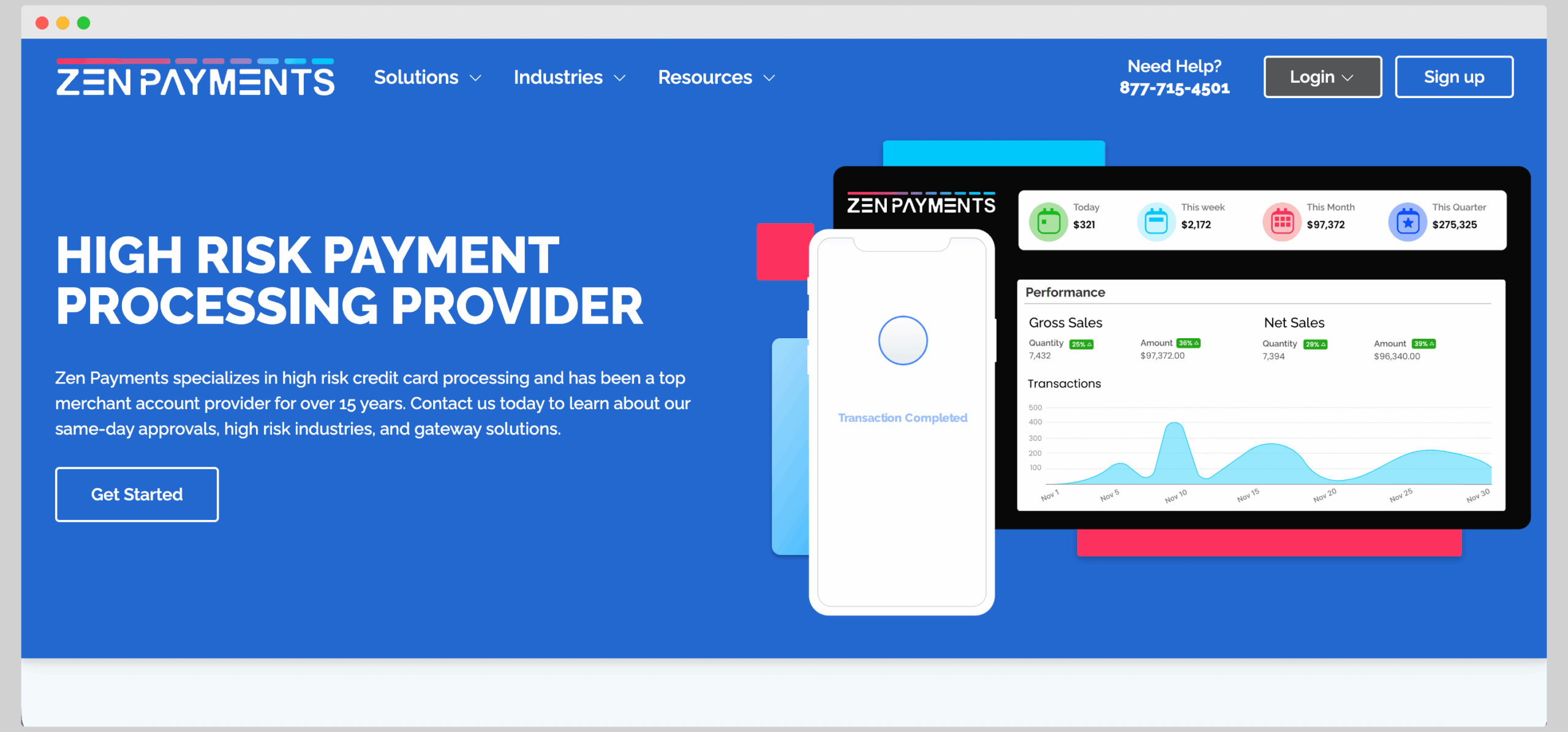
Zen Payments
Quote-based pricing
No setup fee
Competitive rate guarantees
Monthly gateway fees
Very high approval rate
Emphasis on account stability
No hidden fees
Rates not published
Newer company than some rivals
1. TailoredPay: best for companies that need fast approvals
TailoredPay is a high-risk merchant account provider known for fast approvals (often within 24 hours) and transparent pricing. It's built for businesses that struggle with traditional processors, offering daily payouts, chargeback mitigation, and a price-match guarantee on rates.
TailoredPay is the most transparent choice, with exact starting rates and fees so merchants know costs upfront.
This makes TailoredPay the ideal solution for high-risk companies that value clarity, speedy onboarding, and reliable service.
Processing rates start at 2.6% for many high-risk categories (e.g., lending). TailoredPay guarantees industry-minimum rates and will beat competitor offers.
There are no setup or annual fees.Gateway fee of ~$10–$25/month + $0.05–$0.10 per transaction for the payment gateway. No monthly fee for the merchant account itself is explicitly listed.
Chargeback alert service available at $40 per alert, with no setup fee for this service.
Other fees:Daily batch fee may apply (a small daily charge based on volume). No early termination fee is indicated, as they operate on clear, competitive terms (will match or beat rates)
TailoredPay pros
Ultra-fast approvals and payouts: Merchant accounts can be approved in as little as 24 hours, with daily fund settlements to improve cash flow.
Transparent, low fees: Publishes starting rates (e.g., 2.6%) and exact fees (gateway, alerts), with no hidden or setup fees. This high transparency provides clarity in an industry where others hide costs.
Price-match guarantee: Will beat any qualified competitor’s rate, ensuring merchants get industry-lowest pricing without sacrificing service. Also offers strong fraud/chargeback tools tailored to high-risk needs.
TailoredPay cons
U.S.-focused service: TailoredPay primarily serves U.S. businesses (international merchants might need to inquire if coverage extends globally). This focus means some non-US businesses may not be eligible for this high-risk payment gateway.
High-risk only: The company specializes in high-risk industries exclusively – not a general merchant processor. Low-risk businesses are accepted but might find better rates elsewhere.
Underwriting requirements: As with any high-risk provider, merchants must undergo thorough underwriting. New businesses or those with very poor credit/history may need to provide extensive documentation, though TailoredPay does work to approve difficult cases.
2. PayKings: Best for a wide range of high-risk industries
PayKings is a well-known high-risk merchant account provider that works with over 10,000 merchants across many industries.
It’s positioned for businesses that can’t get approved by mainstream processors like Stripe, with high approval rates and dedicated account managers for guidance. PayKings particularly prides itself on accommodating a broad array of high-risk sectors and offering customized solutions for each merchant.
In terms of processing rates, there is a tiered pricing model. Rates typically start around 2.49% for credit card transactions in high-risk categories. Depending on the transaction type and risk level, rates can range from ~2.5% up to 4% (or higher for very risky transactions). Low-risk businesses through PayKings may see rates “as low as 1%,” but high-risk merchants should expect higher tiers
There are no setup fees and no hidden fees are advertised. A monthly account fee is required (exact amount not publicly disclosed; around ~$20–$30 as industry typical). PayKings does charge an early termination fee if you close the account before the contract term – this ETF can be up to $500.
Other fees: Likely includes standard transaction fees (e.g. $0.25–$0.30 per transaction) and possibly a monthly gateway fee if using their gateway (though not explicitly stated on site).
Chargeback fee and fraud tools: PayKings offers chargeback protection services, but specific chargeback fees are not public. (Industry averages ~$25–$30 per chargeback.) All pricing is ultimately customized per merchant, so a quote is needed for precise fees.
We also have a dedicated article on PayKings fees for more information.
PayKings pros
Broad industry acceptance:Extremely wide list of supported industries – PayKings can place merchants from adult to travel to finance, etc., making it a one-stop solution for many high-risk sectors.
No upfront costs: No application or setup fee, and no hidden fees in their marketing. This lowers the barrier to starting. They also provide chargeback prevention tools and work with 20+ banking partners to secure approvals.
Multi-currency support: Able to process in multiple currencies and even cryptocurrencies. Merchants with international customers or crypto payments can benefit from this flexibility. PayKings also offers dedicated account managers for personalized support.
PayKings cons
Opaque pricing without a quote: PayKings does not publish a detailed fee schedule on its own site. Aside from “no setup fees,” merchants have to go through sales to get actual rate quotes, which reduces transparency. The tiered “as low as X%” pricing can be misleading if your business falls into a higher tier.
Early termination fee: They require a contract that carries an ETF (up to $500) if you cancel early. This long-term commitment and potential penalty are drawbacks compared to providers with month-to-month terms.
Mixed responsiveness: Some merchants report that support or underwriting response times can be slow. As PayKings serves many clients, smaller merchants might experience less personalized attention. Additionally, pricing is customized, so some businesses may find quotes less competitive if they don’t negotiate.
3. PayDiverse: Best for flexible underwriting and custom solutions
PayDiverse is a high-risk payment processor emphasizing flexible underwriting and the ability to place merchants that others can’t. It’s ideal for businesses that need a more customized approach.
PayDiverse works with a network of 40+ domestic and offshore banks to find a fit for unusual or very risky ventures. This platform is known for fast approvals (often within days) and robust fraud prevention, making it a top choice for merchants who require quick setup and strong security measures.
Industries supported
PayDiverse can accommodate virtually any high-risk industry through its diverse banking partners. Key examples mentioned include:
Health and wellness
Financial & credit
Travel & ticketing
E-commerce & online services
Other high-risk categories: Adult entertainment (case by case), gaming (fantasy sports, skill gaming), CBD and hemp products vape and tobacco, firearms, tech support, fortune tellers/psychics, and more.
PayDiverse fees
The pricing model is quote-based and customized. PayDiverse does not publish fixed rates; instead, they tailor pricing per merchant and risk profile. They advertise offering the “lowest rates” possible by shopping among many banks. This means your processing rate could range widely – for moderately high-risk, perhaps ~3–5%, and higher for very risky categories – but exact figures require an application.
There is no universal setup fee – many merchants won’t pay an application fee (depends on bank). Monthly fees vary by the banking partner. You should expect a monthly account fee (often around $10–$30) and possibly a monthly gateway fee if using a specific gateway. These are determined case-by-case (PayDiverse’s approach is to combine bank fees with their service, so you’ll get a consolidated quote).
When it comes to transaction & other fees, there are standard per-transaction fees (around $0.25–$0.30 each) on top of percentage rates – again, determined by the chosen acquiring bank. Chargeback fees will apply (often ~$25 per chargeback in the industry), and potential rolling reserves may be required depending on your risk level.
Overall, PayDiverse’s fee schedule has a “low transparency” rating because nothing is published publicly. Merchants will need to engage with their sales team to get specific rates and must carefully review the contract for any ancillary fees. (They do provide educational info about high-risk fees on their site, but not actual prices).
PayDiverse pros
Fast, high approval rates: PayDiverse is known for speedy approvals, often leveraging its large bank network to get merchants set up in as little as a few days.
Flexible underwriting & multiple banks: They work with 40+ banks (including offshore merchant account options), meaning they can match merchants to a bank that accepts their specific industry or profile.
Strong security and fraud tools: PayDiverse puts heavy emphasis on fraud prevention and chargeback mitigation.
Cons
Lack of upfront pricing: There is no published fee schedule – everything is custom and quote-based. This means extra effort for merchants to compare options, and you might need to negotiate to ensure you’re getting a fair rate. The first quote you receive may not be the lowest possible, since pricing “starts as low as…” but can be higher.
Potential for higher fees/reserves: While PayDiverse can often get you approved, the trade-off may be higher processing fees or rolling reserves set by the acquiring bank. Merchants have reported that some partner banks impose significant reserves or slightly higher discount rates, especially for extremely high-risk verticals.
Back-and-forth application process: Because of their multi-bank approach, the onboarding can require additional documentation and communication. You might need to submit a detailed application and then discuss options with their team, rather than an instant signup.
4. SwipeSum: Best for comparing providers and negotiating rates
SwipeSum is a unique platform rather than a traditional processor – it’s best for merchants who want to compare multiple high-risk processing offers and get the best terms. Essentially, SwipeSum acts as a consultant/broker: you fill out one application, and they shop it to their network of acquirers.
This makes it ideal for high-risk companies that have been declined or are paying high fees, as SwipeSum can leverage competition to negotiate lower rates and faster approvals on your behalf.
Industries supported
SwipeSum will try to find a processor for all high-risk categories by using its network. Notable industries it commonly works with include:
In summary, SwipeSum covers all high-risk industries by acting as a matchmaker, from common ones like adult, gaming, CBD, firearms, to more niche ones. If there’s a legal way to process it, SwipeSum will connect you to an appropriate provider.
SwipeSum fees
SwipeSum’s consulting service is typically free for merchants. They earn a commission from processors, so merchants generally do not pay SwipeSum directly to use the platform. There are no application fees to submit your info and get matched.
The actual fees you’ll pay are those of the processor SwipeSum places you with. SwipeSum’s value is in negotiating those lower.
For example, they mention that low-risk accounts might land around 2.6%–3.1% + $0.10 with no reserve, whereas high-risk accounts might be in the 3.5%–6.5% + $0.20–$0.35 range with a 5–15% rolling reserve, depending on the industry. These figures are industry averages; SwipeSum will try to get you toward the lower end of what’s possible for your category.
SwipeSum will help clarify additional fees like monthly fees, gateway fees, and chargeback fees from the chosen processor. They position themselves to eliminate hidden fees – for instance, by ensuring no surprise charges or markups beyond the agreed rates.
SwipeSum’s platform will present the fee proposals from different processors side by side. This helps merchants see the cost breakdown (transaction %, per-item fee, monthly minimums, etc.) and choose the best. SwipeSum prides itself on transparency and expertise, so expect detailed quotes rather than a single number.
SwipeSum pros
One application, multiple offers: SwipeSum streamlines the shopping process – you fill out one set of information and can get matched to multiple acquiring banks or processors that are willing to take your business. This saves enormous time for high-risk merchants who’d otherwise apply to many providers individually.
Expert rate negotiation: The SwipeSum team is a payments experts who negotiate rates and terms on your behalf. Merchants often see lower fees or better conditions (like lower reserves or faster payout cycles) than they could get on their own. Essentially, SwipeSum ensures you’re not overpaying by finding the most competitive option.
Broad network & high approval: SwipeSum works with a wide network of processors and 15+ banks (per their own rankings) and has a very high success rate in placing merchants. Even “hard approval” cases (previous declines or those on MATCH lists) have a strong chance since SwipeSum knows which bank is the right fit. This makes it highly effective for businesses in very challenging verticals or with past issues.
SwipeSum cons
Indirect relationship: When using SwipeSum, you’ll ultimately be processing with a third-party bank/processor. This middleman approach can sometimes be confusing – for support or account issues, you may wonder whether to talk to SwipeSum or the actual processor. Some merchants prefer a direct relationship with their processor for simplicity.
Potential for varied fees: While SwipeSum strives to get the best deal, the fees you end up with still depend on your risk profile and the chosen processor’s terms. Extremely high-risk merchants might still face higher rates or reserves that SwipeSum cannot completely eliminate (they can try to reduce them).
Not a processor itself: SwipeSum doesn’t handle transactions or provide a proprietary gateway – it’s a broker. This means SwipeSum’s speed and outcome depend on external partners. If there are delays in approval or if a processor in their network has issues, SwipeSum can only mediate. In rare cases, merchants might prefer working directly with a processor that also owns the gateway for tighter integration.
5. PaymentCloud: best for hands-on support and new high-risk businesses
PaymentCloud is a popular high-risk merchant account provider focused on e-commerce and hard-to-approve merchants, especially those who have been declined elsewhere.
It’s known for white-glove onboarding – assigning dedicated reps to guide you – which is great for new high-risk business owners unfamiliar with the process.
PaymentCloud works with a variety of acquiring banks to secure approvals in industries like adult, credit repair, travel, etc., and prides itself on a high approval rate.
Industries supported
PaymentCloud supports a broad range of high-risk industries, including:
Adult entertainment
Credit repair and financial services
CBD and supplements
Travel & airlines
E-commerce and online retail
Others: Industries like coaching and seminars, vape and tobacco sales, subscription boxes, furniture (high-ticket items), and more. PaymentCloud covers most “hard to place” businesses with the exception of the very extreme risks. (Notably, they may not accept the most severe categories like illicit substances or unlicensed gambling.
PaymentCloud fees
There is no application or setup fee for merchant accounts. PaymentCloud typically does not charge a setup fee to get started with their payment services. There is usually no monthly minimum fee, either (or it’s low), as they cater to new businesses.
However, expect a monthly account fee in the range of $15–$30 (common for high-risk accounts) and possibly a monthly gateway fee if using their gateway or Authorize.net (often ~$15/month).
PaymentCloud doesn’t publish exact rates online (fee info is “difficult to find”). Generally, high-risk merchants with PaymentCloud report rates around 3%–4% + $0.20–$0.30 per transaction for mid-risk categories, and higher (up to ~5-6%) for very high risk. PaymentCloud tends to use tiered or interchange-plus pricing depending on the merchant.
Chargeback fee is typically ~$25 per incident (not publicly stated, but standard). PaymentCloud might impose a rolling reserve for very high-risk merchants (5–10% held for 6 months, as is industry standard), but many accounts won’t require one. They do not usually have an early termination fee.
Security & privacy are
#1
We use high levels of security & encryption standards to protect your data
High-touch customer service: PaymentCloud provides a dedicated account manager to each merchant. From application through onboarding, they guide you step by step, which is especially helpful for first-timers in high-risk processing. Their support team is known to be responsive and hands-on, easing the setup and integration process.
Fast onboarding and setup: Many merchants report same-day or next-day account setup once approved. PaymentCloud’s team helps quickly turn around paperwork, and they have a high approval success rate by working with multiple banks. This efficient process means minimal downtime for your business after applying.
No-cost processing option: Uniquely, PaymentCloud offers a program for zero-cost credit card processing. This usually means implementing surcharging so the end customer covers the fees. For merchants interested in saving on fees, PaymentCloud can set this up, which not all providers readily do. Additionally, they integrate with a wide range of payment methods (ACH, eChecks, crypto) to give merchants flexibility in how they get paid.
PaymentCloud cons
Limited public pricing info: Fee transparency is not PaymentCloud’s strong suit – specifics on rates and fees are not listed on their website. You’ll need to engage with sales to learn your rates, and some merchants prefer knowing baseline pricing upfront. This can make it harder to comparison-shop without going through the full quote process.
Volume caps for new merchants: PaymentCloud sometimes sets a monthly processing volume limit on high-risk accounts (e.g. you might be capped at ~$50k or $100k/month initially). While this protects against sudden spikes and risk, it can be a drawback if you anticipate rapid growth or have seasonal high volume – you’d need to request increases or have backup processors.
Not for the highest risk extremes: Although PaymentCloud serves many high-risk sectors, it does have some limits. They are not available for extremely high-risk accounts (certain categories like illegal products, unlicensed gambling, etc., are not accepted). In cases of very high chargeback businesses, PaymentCloud may refer you to a partner or require more conditions. So, if you are at the high-risk end, you might need a more specialized provider.
6. Soar Payments: best for dedicated support and moderate fees
Soar Payments is a specialist in high-risk merchant accounts, known for combining competitive pricing with dedicated account management.
It markets itself with “industry minimum pricing” and an instant online quote system for transparency. Soar is a great option for merchants who value having a knowledgeable team on their side – each account often gets a dedicated manager, and Soar has deep experience in high-risk underwriting.
It’s strong for industries like firearms, tactical gear, and subscription services, but supports a broad range.
Industries supported
Soar Payments works with many mid- and high-risk industries, including:
Others: Sectors like fantasy sports, esports/gaming, seminars and coaching, MLM companies, tobacco & cigar businesses, vape/e-cig, web design/SEO services, and more are listed in Soar’s extensive industry list
Soar Payments fees
Soar Payments offers industry-minimum pricing, often using interchange-plus for low-risk and a tiered model for high-risk. They do not post exact rates publicly (you must get a quote). However, merchants typically see rates starting around mid-3% for credit card transactions in many high-risk cases.
For example, some reported starting rates ~3.49% + $0.30 for card-not-present high-risk. Soar emphasizes that its pricing is competitive – it even says they aim to keep fees lower than many providers that “charge exorbitant fees” for high risk.
There is no application fee or setup fee (Soar explicitly does not charge a one-time fee that some competitors do). Monthly fee: Soar typically has a monthly account fee in the ~$20-$35 range (and a monthly gateway fee if applicable). They do have a monthly minimum processing fee clause (ensuring you generate a certain amount in fees or pay the difference), but many high-risk merchants meet it naturally.
The chargeback fee is around $25 per chargeback (common across sources). They also provide an optional Chargeback Armor program (through a partner) that may have its own cost if you opt in. Gateway fees: If using NMI, Authorize.net, etc. through Soar, expect ~$10-$15/month and maybe $0.05 per transaction gateway fee.
Soar Payments pros
Competitive pricing for high-risk: Unlike some providers that gouge high-risk clients, Soar aims for reasonable fees. They often can offer lower rates or at least more straightforward terms (e.g. interchange-plus) for high-risk merchants. Their willingness to match pricing structures to risk means you’re not stuck overpaying if your risk is moderate.
Dedicated account managers: Soar assigns dedicated account managers who specialize in high-risk, providing personalized support. This expertise and one-on-one guidance help merchants navigate any issues, from chargeback management to scaling up volume, with a real person who understands their business.
Instant quotes & transparency: The Instant Online Quote system delivers a preliminary rate quote via DocuSign almost immediately when you apply. This level of upfront info is rare in high-risk processing. Soar also has no hidden fees.
Soar Payments cons
Service exclusions: Soar Payments does not accept certain verticals. For instance, they explicitly prohibit adult entertainment, debt relief, online gambling, and a few others. If you’re in one of those banned categories, Soar isn’t an option. Also, Soar currently serves U.S.-based merchants only (and some Canadian) – it’s not a global solution for merchants outside its supported regions.
Early termination fee on some accounts: While low-risk accounts have none, many high-risk accounts with Soar include a $495 early termination fee if you cancel before the term ends. This can be a downside if you prefer flexibility or might switch providers; you’d want to negotiate this or choose a month-to-month plan if available.
Integration limitations: Soar has slightly fewer integrations with certain third-party software compared to some competitors. For example, if you have a very unusual tech stack, Soar’s gateway options (Authorize.net, NMI, etc.) should cover most needs.
7. Durango Merchant Services: best for experience and international high-risk needs
Durango Merchant Services (DMS) is a veteran high-risk processor with over 20 years of experience, making it a go-to for merchants that need a knowledgeable partner. It specializes in “hard-to-place” businesses, including those with bad credit or high chargebacks.
Durango is known for offering both domestic and offshore merchant accounts, multi-currency processing, and tailored fraud tools. This provider is an excellent choice for businesses that want a stable, long-term solution – especially if you have complex needs like accepting international payments or require an experienced hand in navigating risk management.
Industries supported
Durango serves hundreds of high-risk industries – essentially any legal, high-risk business model. Some notable ones include:
High-ticket and others: High-volume e-commerce merchants, “large ticket” items (luxury goods like fine jewelry and watches), subscription boxes, live animal sales (e.g. pet breeders), antiques & collectibles, firearms (through FFL dealers), tech support, web design services, and many more.
Durango Merchant Services fees
Durango provides custom quotes for each merchant, but typical pricing for high-risk accounts with Durango averages around Interchange + 0.25% on the low end. In practice, merchants see rates roughly in the 3%–7% effective range, depending on risk.
A common scenario: ~4%–5% blended rate for many high-risk e-commerce businesses. Durango does not charge a flat “blanket” rate; they use interchange-plus for transparency. For example, one source notes Durango’s average markup is +0.25% on interchange plus about $0.10 per transaction.
There is around $30 monthly gateway/account fee. Durango typically charges a monthly fee in this ballpark, which covers the cost of maintaining the high-risk account and gateway. They do not have an application fee or setup fee. No annual fee either, generally.
Durango’s sample fees include a $0.10 transaction fee (on top of the percentage) and an authorization fee of $0.15–$0.25 (for each authorization attempt). Chargeback fee is $25 per chargeback incident. Durango is known not to impose early termination fees – they often work on a month-to-month basis with no ETF. Additionally, rolling reserve may be implemented on a case-by-case basis.
If you use Durango to get an offshore account, there may be some extra fees (e.g. foreign exchange or wire fees) associated with those solutions. But Durango’s team will outline them. They do support multi-currency processing without huge surcharges, which is beneficial for global sales.
Durango Merchant Services pros
Deep expertise & reliable service: With decades in the high-risk space, Durango offers experienced guidance and “high-touch” customer service. Their team helps merchants navigate underwriting, risk mitigation, and has seen almost every scenario. This often translates to smoother approvals and operations – many clients praise Durango’s “industry-leading service and tech” and give it excellent reviews.
Flexible options (domestic & offshore): Durango can set you up with domestic processing or offshore merchant accounts if needed. This flexibility is crucial for businesses that might not be approved in the US (due to legal gray areas or high chargebacks). They also support multiple currencies and even cryptocurrency acceptance, enabling truly global sales. Few providers match Durango’s range of banking partnerships worldwide.
Transparent and no long-term contract: Durango’s fee structure, while custom, is relatively transparent about averages (they share typical markups) and they don’t generally lock you into a long contract with penalties. The absence of an early termination fee and the willingness to work month-to-month shows confidence in their service. They also include strong fraud prevention tools (free training, integrations like 3D Secure, AI fraud detection) as part of the package, adding value without hidden costs.
Durango Merchant Services cons
Quote required for pricing: You cannot see Durango’s exact rates and fees until you apply and discuss your business with them. While they provide averages, the lack of upfront pricing means merchants must invest time in getting a quote.
Higher monthly fee: Durango’s monthly account fee (~$30) is on the higher side. In addition, some merchants might find the per-transaction fees (e.g. $0.25 auth fees) somewhat high, especially if doing a lot of small-ticket transactions. These costs can add up for certain models.
Not a fit for every business: Despite its broad reach, Durango still cannot accept every single high-risk scenario. Extremely high chargeback businesses or those in prohibited categories (e.g. outright online casinos in U.S. jurisdictions, illegal substances, etc.) may not find a solution even through Durango’s network.
8. CorePay: Best for custom high-risk solutions and chargeback control
CorePay is a high-risk merchant services provider that focuses on tailored solutions and technology. It’s ideal for businesses that need flexible, customizable payment setups – CorePay offers adaptable pricing models and its own gateway/risk tools to fine-tune processing for different industries.
CorePay positions itself as a modern solution with features like payment orchestration, in-house chargeback mitigation (through its sister company CB-Alert), and strong e-commerce integrations.
Industries supported
CorePay supports a wide array of high-risk industries, such as:
Online gaming & adult entertainment
CBD and cannabis-related
Firearms and tactical gear
Credit repair, tech support, and financial
Travel, telemedicine, subscription
High-risk e-commerce: Everything from multi-level marketing products to fantasy sports, from vape products to “creator content” (e.g. OnlyFans-style platforms) is supported. CorePay basically covers most high-risk verticals except those that are illegal; as PayCompass noted, “besides adult businesses, it supports online dating, firearms, and others” – implying adult is included too.
CorePay fees
CorePay offers extremely competitive, customizable pricing, often interchange-plus or flat rate depending on merchant preference They do not publish standard rates, but they highlight that you won’t be stuck with exorbitant fees misaligned to your risk – they adjust pricing to your profile.
In practice, this means if you’re on the lower end of high-risk, CorePay might get you rates closer to low-risk processors (maybe in the 2.5%–3.5% range). For higher risk, rates will be higher, but CorePay tries to keep them “fair and manageable”
No setup or application fees, and no annual fees according to third-party comparisons. CorePay likely charges a standard monthly fee (often ~$20) for account maintenance and possibly a gateway fee if using their proprietary gateway (NetValve).
However, they often bundle services, so merchants have reported not being nickel-and-dimed. They emphasize transparency – no surprise monthly fees beyond what’s disclosed.
CorePay provides its CB-Alert chargeback alert and management system (possibly at an extra per-alert cost, though this isn’t specified publicly). But having in-house tools might save merchants money compared to third-party services. Chargeback fees are typically around $25 each, standard if a chargeback occurs. CorePay’s approach is to minimize those through its tools.
There are no early termination fees (CorePay appears to do month-to-month agreements). Also, no monthly minimum processing requirement has been mentioned – meaning if your volume is small, you’re not penalized, which is good for new businesses.
CorePay pros
Customized pricing and solutions: CorePay really shines in tailoring everything – from flexible pricing structures to industry-specific features.
Advanced risk mitigation: CorePay invests heavily in risk management. They provide in-house chargeback management (CB-Alert) and advanced fraud prevention with real-time monitoring and machine learning.
Strong integrations and tech support: CorePay offers a proprietary gateway (NetValve) as well as integration with Shopify, WooCommerce, and over 175 shopping carts and platforms. They also support payment orchestration – allowing large merchants to route transactions across multiple processors for load balancing.
CorePay cons
Pricing not openly advertised: CorePay’s lack of published rates can be frustrating (similar to others). While they tailor pricing, this also means initial transparency is low – you must contact them to get a quote. Some merchants might prefer at least a ballpark idea without having to engage in sales discussions.
Focus on MOTO and specific niches: According to one source, CorePay “heavily focuses on MOTO payments” as a specialty. This isn’t necessarily a negative, but it could imply that if you’re purely an online retail (e-commerce) merchant, you’re just one of many types they serve.
Still need underwriting: CorePay isn’t an instant aggregator like Stripe – you’ll undergo a full underwriting. New or very risky businesses might face strict requirements or even declines if they are truly untenable.
9. PayProcc: Best for matchmaking high-risk merchants with processors globally
PayProcc is a platform that connects mid- and high-risk merchants to a large network of 1500+ payment solutions and banks worldwide.
In other words, PayProcc acts as a bridge or broker, finding you a suitable processor or gateway for your specific high-risk business. This makes PayProcc best for merchants who want a one-stop service to explore many processor options, especially international merchants needing a solution in different regions. PayProcc simplifies the process by having you apply once on their platform and then leveraging their network to secure an account.
Industries supported
Since PayProcc works with so many providers, it covers all major high-risk industries, including:
Everything else: High-risk is broad – PayProcc mentions connecting merchants in areas such as dating sites, gaming, forex, travel, software, e-commerce with high chargebacks, etc.
PayProcc fees
PayProcc itself typically does not charge merchants a direct fee to use the service (no upfront cost to be listed or matched). They earn through referral commissions from the processors or via a small portion of the processing fee.
There are no membership fees for merchants disclosed publicly; signing up and getting matched is free. (PayProcc does have “Memberships” mentioned on their site possibly for partnered providers or value-added services, but not for basic matchmaking.)
Processing fees will vary widely based on which processor you end up with. PayProcc’s value is presenting you with options. Some of their partners might offer rates as low as ~3% for certain high-risk, while others dealing with extreme risk (like gambling) could be 10%+.
PayProcc’s users have noted that sometimes the fees can be high or unclear from some processing partners. For instance, a merchant might get an offer but then find out the processor adds a lot of extra fees. PayProcc itself doesn’t add extra on top, but the partner’s fees might include reserves, higher per-transaction costs, etc.
PayProcc’s system presumably lets you compare different processor offers. However, some users mentioned confusion about “unexpected fees or hidden charges” from the processors, implying that not all costs were clear initially.
PayProcc pros
Huge network – almost guaranteed placement: PayProcc connects with over 1,500 payment methods and processors globally. This means that even if you’ve been rejected multiple times, PayProcc likely knows a provider somewhere (domestic or international) that will accept your business.
Ease of use and integration: Users report that PayProcc’s platform is user-friendly and easy to integrate with other systems. They help with a smooth onboarding – one customer noted the onboarding was seamless with good customer support assistance.
Great customer support and guidance: Many merchants appreciate PayProcc’s customer support in guiding them through the process. Because high-risk processing can be confusing, PayProcc’s team helps compare features and ensure you understand what you’re signing up for.
PayProcc cons
Potential for high fees via partners: One common criticism is “high fees, particularly due to unclear additional charges from payment processors” in PayProcc’s network. Some users felt the processors they were matched with had unexpected or higher-than-expected fees.
Lack of direct control: When using PayProcc, you are adding an intermediary. While PayProcc itself is reportedly helpful, you ultimately will be dealing with the chosen processor for day-to-day operations. If issues arise (like payout delays or technical issues), you might need to coordinate between PayProcc and the processor.
Less transparency on features/terms until signup: Because PayProcc pulls in various solutions, it might not be immediately clear which features you get until you review each processor’s offer. Users wished for more guided info (like videos or documentation) on the platform itself about the differences between solutions. This can feel a bit opaque until you get your matches.
10. Payline Data: Best for transparent pricing and omnichannel solutions
Payline Data is a reputable merchant services provider that also accommodates many high-risk industries (through specialized underwriting), making it a strong option for merchants who want transparency and a full suite of payment options in high-risk payment processing.
Payline is known for openly posting its pricing for low-risk services and maintaining a month-to-month, no cancellation fee policy. For high-risk accounts, Payline often partners with banks or even with other high-risk ISOs (like PaymentCloud) to get approvals.
Industries supported
Payline accepts many high-risk industries, though each is subject to underwriting. Some of the high-risk categories Payline works with include:
CBD & cannabis-related
Nutraceuticals & supplements
Subscription boxes & continuity
Firearms & tactical gear
Adult content and collectibles
High-risk e-commerce & others: They also handle general “complex industries” and hard-to-place merchants, including certain travel businesses, credit repair, MLM, vape products, tech support, and more (likely via partner banks). Essentially, Payline says, “if it’s legal, we’ll find a way to support it.”
Payline Data fees
Payline Data is known for interchange-plus pricing. For standard-risk merchants, they publish rates like Interchange + 0.2% + $0.10 for swiped cards. High-risk merchants will face higher markups: according to Merchant Maverick, Payline’s interchange-plus rates are higher than most processors charge (reflecting the added risk).
You might expect something like Interchange + 1% – 1.5% (or more) for high-risk categories. For example, if interchange on a card is 1.8%, Payline might charge you 1.8% + 1.0% = 2.8% for that transaction, plus a per-transaction fee. In practice, many high-risk Payline merchants see effective rates around 3.5% – 5% depending on the risk and card mix.
There is no application fee, no cancellation fee, no long-term contract. Payline is month-to-month. They even advertise the first month free for new accounts.
Monthly fee: Payline typically has a $20/month fee for the gateway/account for low-risk. For high-risk accounts, if partnered via another ISO, the monthly fee could be around $25 or more. But overall, Payline tries to keep monthly fees low. They also do not charge PCI compliance fees (that’s free)
Other fees:Transaction fee on top of percentage – for card-not-present, Payline lists $0.10 for low-risk, but high-risk might be $0.25. In fact, Payline’s own high-risk pricing table (from HighRiskPay integration) shows High Risk: 2.95% + $0.25 per transaction, Adult: 2.95% + $0.50. Those are example flat rates; Payline’s actual offer might vary but gives a sense that around 3% + a quarter is a baseline for high-risk.
Chargeback fee: Payline will pass through whatever the acquiring bank sets (commonly $20–$30). There’s usually no early termination, as mentioned. Monthly minimum: Payline’s standard accounts have a monthly minimum fee of $25 (i.e. you need to generate ~$25 in processing fees or pay the difference). For high-risk, if that applies, it means if your volume is very low, you might still pay up to $25 in fees. Most active merchants won’t notice this.
High-risk surcharge: Payline might incorporate a rolling reserve or a higher discount rate for certain very risky merchants. Their partnership with PaymentCloud suggests that some high-risk accounts through Payline are actually boarded with PaymentCloud and thus follow those fees.
Payline Data pros
Transparent pricing and contract: Payline has a reputation as one of the first to list fees clearly on its website. Even for high-risk, they uphold the principle of transparency: you won’t find hidden surcharges popping up.
Omnichannel and integrations: Payline offers full omnichannel solutions – you can do in-person payments (they provide free or low-cost terminal options, support Clover, etc.), online payments, mobile, and even ACH. High-risk merchants with a retail component or point-of-sale can use Payline as a single provider across all channels.
No extra or surprise fees: Pros highlighted by reviews include no early termination fee, no monthly minimum for some accounts, no application fee, etc. For high-risk, they do often keep the no ETF policy, which is great (you can leave if you’re unhappy, without penalty).
Payline Data cons
High-risk rates can be on the higher side: While Payline is transparent, it’s noted that their interchange-plus markups for high-risk are somewhat high. In other words, you pay a premium for the transparency and service. Some strictly price-shopping merchants might find slightly lower rates elsewhere (albeit perhaps with less transparency or on tiered pricing).
US-only for high-risk accounts: Payline primarily serves U.S. merchants. International high-risk merchants might not be eligible. Additionally, even though they can do multi-currency via partnerships, those solutions might actually be through other providers.
Relies on partner for some high-risk placements: Payline can handle many high-risk internally, but as noted in a source, they sometimes partner with PaymentCloud for high-risk referrals. This means if you apply to Payline and they deem you too risky for their core acquiring bank, they’ll hand you off to their trusted partner (PaymentCloud) who will then underwrite you.
11. HighRiskPay: Best for easy approval of merchants with bad credit
HighRiskPay is a specialized merchant account provider dedicated to high-risk businesses and those with bad credit histories. It markets itself with a 99% approval rate, even for merchants that have been turned down elsewhere.
HighRiskPay’s key appeal is its simple, flat-rate pricing structure that is the same for almost all high-risk merchants, making it very straightforward.
It also touts fast approvals (often within 24–48 hours) and no setup fees, catering to small businesses and startups that need a quick, no-fuss solution.
Industries supported
HighRiskPay accepts virtually all standard high-risk industries, for example:
Adult entertainment
CBD and supplements
Travel & airlines
Online gambling & gaming
Tech support and subscription
Financial and collections
Others: Firearms, e-cigarette and vape vendors, multi-level marketing, online pharmacies, ticket brokers, sportsbook, and startup businesses in any high-risk field are all within HighRiskPay’s scope.
HighRiskPay fees
HighRiskPay uses a simple flat pricing model. According to their published rates, most high-risk accounts are at 2.95% + $0.25 per transaction. They even show specific tiers: e.g. “High Risk 2.95% + $0.25” and “Adult Merchant 2.95% + $0.50” (slightly higher per item fee for adult).
Some lower-risk “high risk” (if that makes sense) might get 1.79%–2.95% depending on credit, but generally 2.95% is the go-to rate for card-not-present high risk. These rates are flat and not heavily negotiable, which means not the absolute lowest for every scenario, but very transparent.
Monthly fee:$9.95 per month. This is relatively low compared to industry peers (many charge $20-$30). HighRiskPay prides itself on low monthly fees. There’s also no monthly minimum volume fee explicitly mentioned, so presumably you just pay the $9.95 regardless of volume.
Transaction fee as noted ($0.25 to $0.50 depending on industry) in addition to the percentage. Setup fee: None.
Application fee: None.
PCI fee: None mentioned. They highlight “no setup fees” and straightforward costs. Early termination fee: $0 – they have no long-term contract; it’s month-to-month. Chargeback fee: likely around $25 (they don’t publish it on the site snippet we have, but this is standard).
HighRiskPay pros
Easy approval, even with bad credit: HighRiskPay is particularly known for approving merchants with poor credit or previous problems. They claim a 95% approval for bad-credit businesses and 99% for others.
Simple, fixed pricing: The flat-rate pricing brings high transparency – every transaction’s cost is predictable, and there are no surcharges for different card types or other hidden fees.
Fast setup and integration: They advertise approvals in as fast as 24–48 hours, which means you can start processing quickly. Also, HighRiskPay states they work with most payment technologies – in-person, online, subscriptions, etc.
HighRiskPay cons
Flat rates can be less competitive for some: The convenience of a flat 2.95% comes at the cost of maybe paying more than necessary if your business actually isn’t that risky or if you process a lot of debit cards. For example, if you have mostly low-risk transactions, 2.95% is high compared to an interchange-plus deal elsewhere.
Limited information on advanced services: HighRiskPay doesn’t publicly detail things like whether they offer advanced fraud tools, chargeback alerts, or specific integrations. They likely have a standard gateway and basic fraud scrub, but for merchants needing sophisticated anti-fraud or analytics, HighRiskPay might not have as robust a suite as some bigger providers.
No same-day funding option: Unlike some competitors, HighRiskPay doesn’t appear to offer same-day deposits. Also, no in-house POS equipment programs are mentioned – if you need a fancy integrated POS, you might have to get it separately (though they can work with virtual terminals and existing processors).
12. Zen Payments: Best for fast approvals and rescuing frozen accounts
Zen Payments is a high-risk payment processor that has quickly gained momentum due to its fast-approval ethos and willingness to take on merchants coming from platforms like Stripe or Square that froze their funds.
Zen partners with a network of banks (15+ acquiring institutions) to achieve a 98% approval rate for high-risk applications. They also promise never to freeze or shut down your account without notice, addressing a chief pain point of high-risk merchants.
Industries supported
Zen Payments supports a diverse range of industries, including:
Coaching and consulting
Firearms & weapons
Gaming and fantasy sports
Multi-Level Marketing
Nutraceuticals & supplements
Subscriptions and SaaS
Telemedicine and healthcare
Travel & ticketing
Additionally, although not explicitly listed in the snippet, Zen likely supports typical high-risk categories like adult entertainment, CBD, credit repair, etc., either directly or via their partner network.
ZenPayments fees
Zen Payments does not publicly disclose specific rates, but they do offer a “competitive pricing guaranteed” promise – they will beat your current processing rates if you have 3+ months history. This suggests they’re flexible and aim to undercut other high-risk providers. If you’re currently at say 4%, they might offer 3.8%, for example.
Generally, merchants report Zen’s rates to be on par or slightly better than competitors. We might infer typical rates in the ~3%–4%+ range depending on industry. Because they use multiple banks, some accounts might be interchange-plus and others tiered.
But importantly, no hidden fees are charged, and they pride themselves on transparency in pricing terms (everything disclosed in the contract) for your business bank account.
Zen doesn’t charge setup or application fees (they often advertise free setup). Monthly fees are likely in line with industry, possibly around $20-$30 for the gateway and support. They explicitly guarantee no hidden fees, and it’s noted in a review that if there are any additional fees, they clarify them (e.g. chargeback program costs).
They also don’t charge annual fees.
Early Termination: Not clearly stated, but given their stance, they likely do not enforce harsh term contracts. Zen seems to operate with confidence that you’ll stay because you like them, not because you’re locked in.
Chargeback fee – probably standard ~$25. Zen does have chargeback prevention programs (though details “not on website”), which might come at some cost if you opt in (for example, if they integrate Chargeback Gurus or similar, there might be per-alert fees).
Gateway fee: If using NMI or Auth.net via Zen, expect ~$10/month and a small per-transaction gateway fee. Possibly Zen waives some gateway costs if volume is high or as part of beating your current deal.
Reserve: Zen doesn’t mention reserves upfront, but they likely tailor that to the merchant; if your industry requires one by acquiring bank, they’ll tell you, but they do highlight giving notice and not freezing accounts arbitrarily. They emphasize stability, so if a reserve is needed, they’d implement rather than abruptly hold funds.
ZenPayments pros
Very high approval rate & fast onboarding: Zen boasts about 98% approval rates for high-risk merchants. They leverage many banking partners to find a fit for almost everyone. This, coupled with quick turnaround (they often approve within a day or two), means if you’re desperate after a Stripe shutdown or other rejection, Zen is extremely likely to get you processing again promptly.
No hidden fees & rate match guarantee: Zen’s promise of no hidden fees and willingness to beat your current rates makes them stand out. Merchants can trust that the rate and fees they agree on are what they’ll pay – there won’t be mysterious charges later.
Multiple bank relationships = account stability: Zen’s network of 15+ financial institutions means they have a high risk tolerance collectively and can route your account where it fits best. It also means if one bank faces an issue, Zen could potentially migrate you to another without you having to find a new processor yourself.
Zen Payments cons
No published pricing (quote required): While Zen will likely give you a great deal, you do have to go through a quote process. They don’t list pricing on their site, citing the tailored nature. This lack of upfront rate info could be a minor inconvenience if you’re comparison shopping – you must contact them to know what you’d pay.
Possibly excludes a few extreme verticals: Zen Payments covers most high-risk industries, but some very high risk categories (e.g., unlicensed pharmacies, illicit products, certain gambling) likely remain off-limits. They don’t advertise adult or gambling on their site explicitly; it’s possible they handle them on a case-by-case basis or via offshore partners.
Relatively new player: Zen was established in 2017 and, while it has an A+ BBB rating and good reviews, it’s a younger company in this space. There are no significant negative reports, but being newer means they don’t have the decades-long track record of, say, Durango or CCBill. For some risk-averse merchants, this might be a slight concern.
Wrapping up
Choosing a high-risk merchant account impacts your entire business. If you want to accept credit card payments easily, get advanced fraud prevention tools, and avoid frequent chargebacks, the right partner can save you from a lot of headaches.
At TailoredPay, we give you a high-risk merchant account that works for you, regardless of your industry. We offer transparent merchant account fees, secure payment processing, fast approvals, chargeback protection and excellent fraud protection tools, for businesses just like yours.
Frequently asked questions
What is a high-risk industry?
A high-risk industry is any business category that banks associate with higher levels of chargebacks, fraud, refunds, or regulatory issues. Industries like adult services, CBD, travel bookings, subscription models, and online finance often fall into this category because transactions are more likely to be disputed. The classification is based on risk patterns, not on whether the business is legal.
What should I look for in a high-risk merchant account?
You should look for transparent fees, a provider that clearly explains reserves and payout timing, and real experience with your specific industry. Good providers also offer fraud protection tools, quick account setup, and responsive support when issues arise. Stability is just as important as approval speed.
How much do high-risk merchant accounts cost?
Costs depend on your industry, volume, and history, but high-risk accounts usually charge higher processing rates than standard merchant accounts. You may also see monthly fees, chargeback fees, and sometimes a reserve where part of your funds are temporarily held. The total cost varies widely based on how risky the provider considers your business.
What makes a business high risk, other than the industry?
A business can be considered high risk due to high chargeback rates, inconsistent sales volume, or poor credit history. Being a new business, operating internationally, or using subscription billing can also increase risk in the eyes of banks. Even changes in customer behavior or regulatory pressure can affect risk classification.