Venmo Account Suspended? Here’s Why + How to Fix It

Having your Venmo account suspended can be very unpleasant, especially if you’re using it for your business. If it’s your personal account, the damage may not be as bad. However, a frozen account for your business can mean failed payments and bring your entire operations to a halt.
Here is why Venmo suspends user accounts and what you can do to prevent it.
Get approved for a merchant account in less than 24 hours
A suspended Venmo account: top reasons
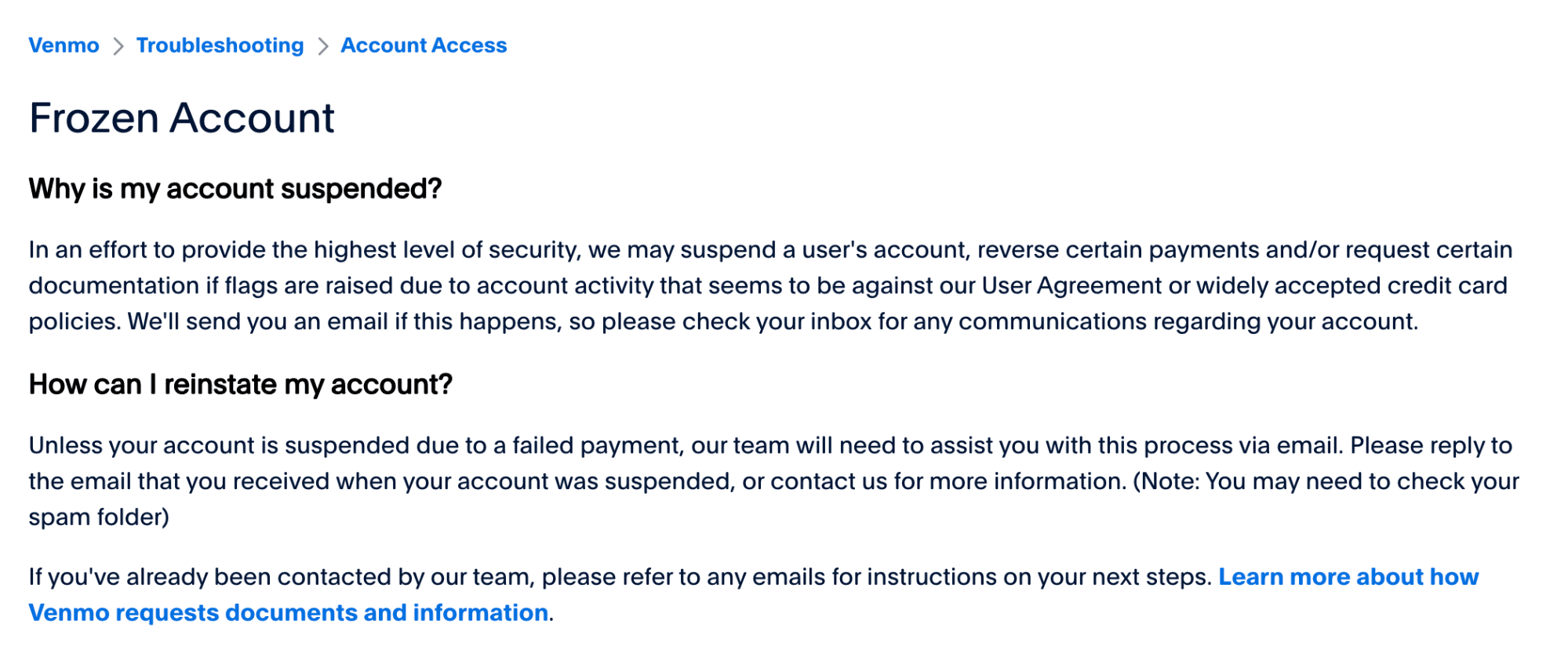
When it comes to personal accounts, suspensions happen because of common issues like a negative balance/insufficient funds or debit card problems.
For businesses, the situation is a bit different.
Venmo suspends accounts for two common reasons: to protect you as the seller or your customers. If we go a bit deeper, there are a few situations when suspensions usually happen.
Selling prohibited or restricted goods
Venmo closely monitors what businesses sell. If your account is linked to products or services that fall outside its acceptable use rules, a suspension is likely.
Common examples include:
- digital goods with resale risk
- adult content
- gambling-related services
- supplements with unverified claims
- travel agencies
- CBD and other regulated products
- financial services that involve lending or investment activity
- and many others.
Even legal businesses can be restricted if Venmo does not support the category.
This is one of the fastest ways for a business account to get flagged.
Get approved for a merchant account today
High dispute or chargeback activity
Venmo tracks payment reversals, customer complaints, and unauthorized transaction claims. A spike in disputes can signal potential fraud or poor fulfillment practices. Simply put, they see suspicious activity on your account.
If customers frequently claim they did not receive what they paid for, or report transactions as unauthorized, Venmo may freeze the account while reviewing activity. In many cases, funds are held until the review is complete.
Using Venmo like a traditional merchant account
Venmo is not designed to function as a full-scale payment processor. Businesses that process a high volume of payments, large ticket transactions, or rapid payment cycles often trigger automated risk checks.
This includes situations where Venmo is used as the primary checkout option for online sales, subscriptions, or recurring billing. These patterns resemble credit card processing behavior, which Venmo does not support well for many businesses.
Mismatch between account details and activity
Venmo expects business profiles to accurately reflect who you are and what you do. Suspensions often happen when there is a mismatch between the registered business name and the actual seller, the stated business type and transaction descriptions, or the linked bank account and ownership details.
Incomplete verification or outdated account information can also lead to restrictions, especially during routine compliance reviews.
Suspicious or unusual payment patterns
Sudden changes in transaction volume, repeated payments from new users, or many payments of the same amount in a short period can look suspicious to Venmo’s monitoring systems.
These patterns are sometimes associated with fraud, money movement schemes, or account sharing. Even legitimate promotions or viral sales spikes can cause temporary suspensions if not explained.
Violations of Venmo’s terms for business use
Some businesses unknowingly break the rules by accepting personal payments instead of business payments, trying to avoid fees by routing transactions through personal accounts, or encouraging customers to use notes that misrepresent the transaction.
Venmo actively looks for this behavior. Once detected, it often results in immediate account limits or suspension since you’re not respecting their user agreement.
Top ways to unblock a suspended Venmo account
If your Venmo business account is suspended, there is no instant fix. Most restrictions are tied to compliance checks, risk reviews, or policy violations. That said, there are a few proven steps that give you the best chance of getting the account restored or, at least, having your funds released.
Check the exact reason for the suspension
Start by reviewing all messages from Venmo, both in-app and via email. Venmo usually states whether the issue is related to verification, account activity, disputes, or acceptable use rules.
Do not guess the reason. Your response should match the specific concern Venmo raised. A generic appeal often leads to delays or rejection.
Complete all requested verification steps
Many suspensions stay in place simply because the required documents were never submitted or were incomplete.
This may include a government-issued ID, proof of business ownership, tax information, bank account verification, or details about your products and services. Upload clear documents, make sure names and addresses match exactly, and avoid partial submissions.
Contact support directly and clearly
Reach out through Venmo support using the official contact form or in app chat. Keep your message short and factual.
Explain what your business does, how you use Venmo, and confirm that your activity follows their rules. If you made a mistake, acknowledge it. Avoid emotional language or blaming the platform, as that often works against you.
Resolve disputes and refund buyers when possible
If the suspension is tied to disputes or complaints, resolving them can help. Issuing refunds, providing proof of delivery, or showing customer communication may improve your case.
Venmo wants to see that buyers are not at risk. Demonstrating good faith actions can speed up reviews, especially for temporary limits.
Correct account setup issues
Make sure your account is set up as a business profile, not a personal account used for selling. Update your business description so it accurately reflects what you sell.
Also double check linked bank accounts, legal business name, and ownership details. Inconsistencies are a common reason reviews stall.
Wait out temporary reviews when required
Some suspensions are purely precautionary. If Venmo states that your account is under review, there may be no action you can take besides responding to requests and waiting.
Repeated messages during this stage usually do not help. Reviews often take several business days, sometimes longer for higher-risk activity.
Prepare for a permanent limitation outcome
In some cases, Venmo will decide that your business model is not supported. When this happens, the account may not be reinstated as it poses a high risk of fraudulent activity.
If Venmo allows fund withdrawal after the holding period, follow those instructions carefully. At that point, your focus should shift to using a payment provider built for business transactions rather than trying to reopen the same account.
Why a high-risk merchant account is a better alternative to Venmo for business
Venmo is convenient, but it was never built to support ongoing business payments, especially in regulated or higher risk categories. If your account was suspended, that is usually a sign that the platform is not a good fit for how your business operates.
A high-risk merchant account such as TailoredPay is designed for businesses that Venmo often restricts or shuts down.
Built for regulated and higher risk industries
High-risk merchant accounts support industries that Venmo commonly blocks or limits. This includes CBD, supplements, digital services, subscriptions, coaching, adult-related products, and businesses with international customers.
Instead of relying on vague acceptable use rules, these providers underwrite your business upfront. Once approved, you are far less likely to face sudden shutdowns for doing exactly what you were approved to do.
Proper underwriting instead of reactive suspensions
Venmo relies heavily on automated monitoring. Accounts are often frozen after activity spikes or pattern changes, even when nothing is wrong.
High-risk providers review your business model, products, pricing, and fulfillment process before activation. This upfront review reduces surprise suspensions and payment holds later on.
Support for real business payment flows
Venmo struggles with recurring billing, subscriptions, higher transaction volumes, and larger ticket sizes. These patterns often trigger reviews or limits.
High-risk merchant accounts are built for card payments, recurring charges, and consistent sales volume. You can scale without worrying that growth itself will get your account flagged.
Clear dispute and chargeback handling
Venmo offers limited tools for managing disputes, and repeated claims can quickly lead to account restrictions.
High-risk processors provide structured chargeback management, alerts, and prevention tools. This gives you more control and visibility when something goes wrong, instead of an immediate freeze.
More predictable access to funds
Venmo suspensions often come with frozen balances and unclear timelines. For businesses, this creates cash flow problems fast.
While high-risk merchant accounts may have rolling reserves or slightly longer settlement times, the rules are defined upfront. You know when and how you get paid, which makes planning far easier.
A payment setup that matches your risk profile
The biggest issue with Venmo is the mismatch. It is optimized for casual payments, not commercial risk.
A high-risk merchant account accepts that risk exists and prices for it transparently. In return, you get stability, clearer rules, and a payment system that aligns with how your business actually runs.
Get approved for a merchant account in less than 24 hours