7 Top Hard to Place Merchant Services for Payment Processing

If your business is hard to place for credit card processing, it’s not impossible. Hard to place businesses struggle with getting approved by traditional payment processors that were not built with high-risk industries in mind.
However, there are dedicated payment solutions that allow hard-to-place businesses to accept credit card payments without delays, frequent chargebacks, and risks of fraud. Today, we show you the best high-risk payment gateways built for businesses that traditional processors won’t approve.
Get approved for a merchant account in less than 24 hours
What does it mean when a business is hard to place?
When a business is described as hard to place for payment processing, it means payment processors and acquiring banks are reluctant to approve or support the merchant account. This usually happens because the business is seen as higher risk than average, or because it does not fit standard underwriting rules.
Here is what that typically implies in practice.
Higher perceived risk
Banks may expect higher chargebacks, refunds, fraud, or regulatory exposure. Industries like supplements, online coaching, travel, adult content, crypto-related services, and subscription-based models often fall into this category.
Limited processor options
Many mainstream processors will decline the application outright. The business may need a specialist high-risk provider or an acquiring bank in a different region.
Stricter underwriting
Approval often requires more documents, such as processing history, bank statements, supplier agreements, marketing materials, refund policies, and proof of delivery.
Tougher account terms
Accounts may come with rolling reserves, higher transaction fees, delayed payouts, lower monthly volume caps, or limits on accepted payment methods.
Longer approval timelines
Instead of instant or same-day approval, underwriting can take days or weeks, especially if compliance teams need to review the business model in detail.
Ongoing monitoring
Even after approval, these accounts are monitored more closely. Sudden volume spikes, changes in offer, or rising chargeback ratios can trigger holds or account termination.
In short, hard to place means the business can still process payments, but it requires the right banking relationships, more patience during setup, and acceptance of stricter terms compared to standard low-risk merchants.
Hard-to-place businesses need high-risk merchant accounts
Hard to place businesses often struggle with regular processors like Stripe because those platforms are built for low-risk, standardized business models. When a company falls outside those boundaries, approvals fail, or accounts get shut down after launch. A high-risk merchant account is structured specifically to support these cases and solve the issues that mainstream processors avoid.
Approval for complex business models
High-risk providers underwrite businesses that sell subscriptions, digital services, future delivery products, or operate in regulated industries.
Instead of automatic rejections, the business model is reviewed in context, which leads to approvals that would not be possible with Stripe.
Stable processing without sudden shutdowns
Regular processors rely heavily on automated risk systems. A spike in volume, refunds, or disputes can freeze funds instantly. High-risk merchant accounts use manual oversight and predefined rules, which reduces the chance of unexpected account termination. You get predictable payment processing costs that are only a fraction higher than with traditional payment gateways.
Support for higher chargeback thresholds
Stripe enforces strict dispute limits that many hard-to-place businesses exceed early on. High-risk accounts are built with higher tolerance levels and offer guidance on managing disputes before they become a serious problem.
More flexible payout and reserve structures
While high-risk accounts may include rolling reserves, these terms are disclosed upfront and negotiated in advance. Stripe often applies holds after issues appear, leaving businesses without access to cash when they need it most.
Access to global banking relationships
High-risk processing providers work with acquiring banks that actively accept industries that Stripe avoids. This opens access to card networks, regions, and payment methods that standard processors simply do not support.
Human support and risk guidance
Instead of generic emails or automated alerts, high-risk merchants get direct access to risk teams who understand their industry. This helps businesses adjust offers, billing flows, and policies before problems escalate.
Top hard-to-place merchant accounts to help your business with payment processing
While traditional merchant accounts like Stripe or Square are unwilling to take on businesses in high-risk industries, there are plenty of options out there. High-risk merchant services allow your business to get paid without interruptions, with strong chargeback and fraud protection tools.
These are the best options for payment processing if your business is hard to place.
TailoredPay
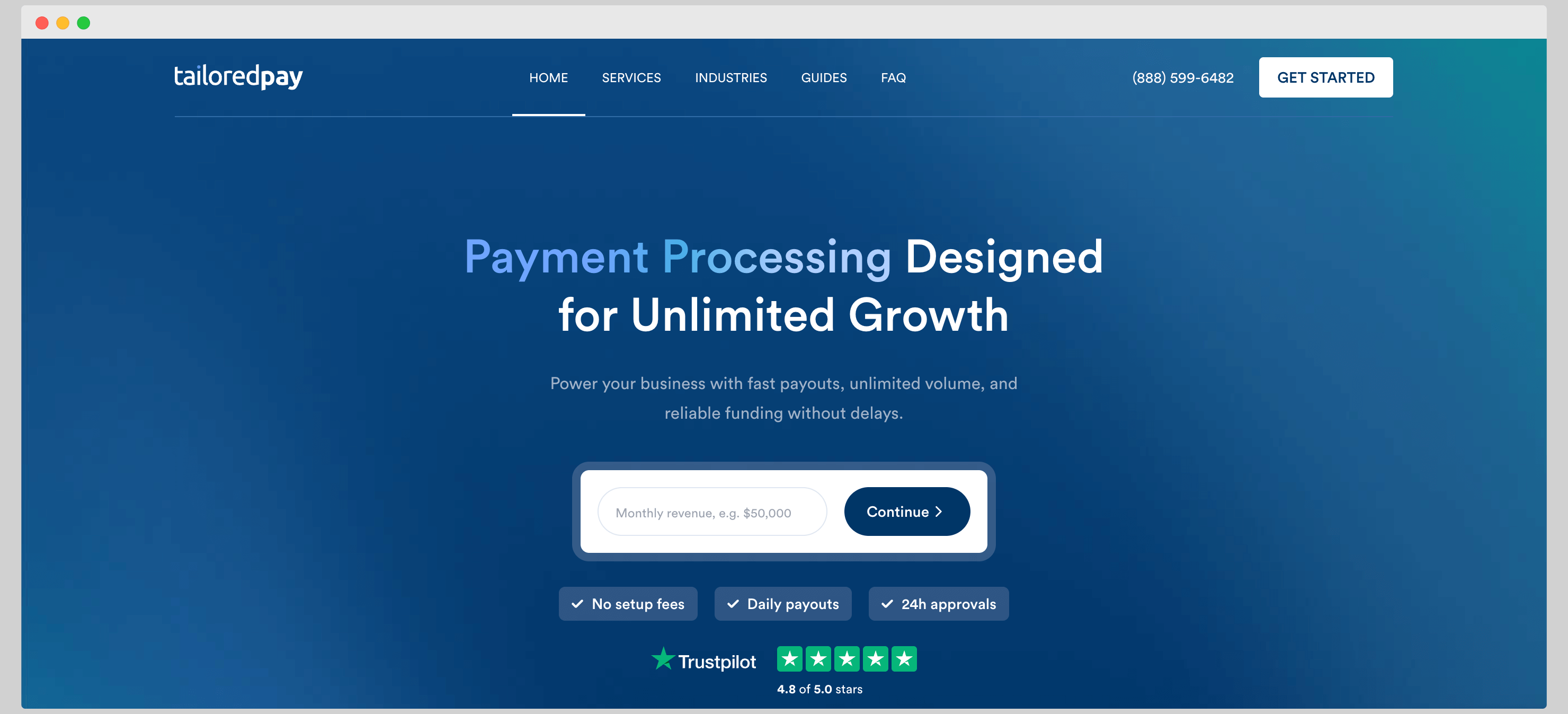
TailoredPay is a high-risk merchant account provider built specifically for businesses that are hard to place with traditional processors. It is used by online and international merchants operating in regulated, high-chargeback, or bank-sensitive industries that need reliable payment processing without sudden shutdowns.
TailoredPay works with a wide range of high-risk and hard-to-place industries, including:
- CBD and hemp products
- Adult services and adult content
- Online dating platforms
- Travel and booking services
- Subscription-based businesses
- Coaching and online education
- Lead generation and marketing services
- Consulting and professional services
- Digital products and SaaS
- High ticket ecommerce
Pricing is tailored to each business, based on its risk profile, processing volume, and history.
Fees may include higher transaction rates than low-risk merchant accounts, rolling reserves where required, and custom settlement terms. All conditions are defined upfront during underwriting, with a focus on long-term account stability rather than short-term approvals.
Best for: hard-to-place merchants that need a long-term, stable, high-risk merchant account with transparent terms and hands-on support across complex industries.
PayKings
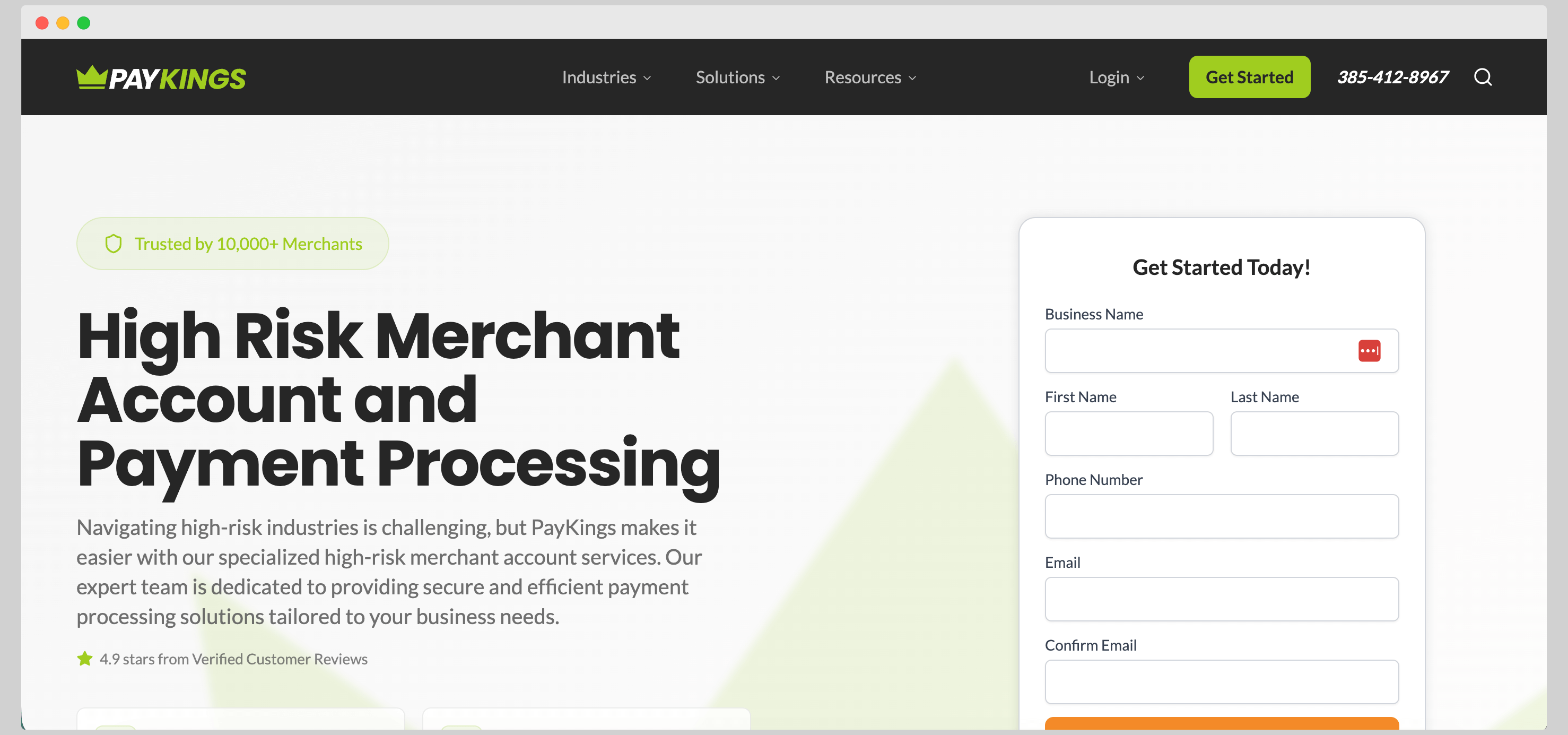
PayKings is a US-based high-risk merchant account provider that specializes in placing businesses rejected by traditional processors. It is commonly used by online merchants operating in regulated, restricted, or high chargeback industries that need a stable payment setup rather than quick signup tools.
The company supports a wide range of hard-to-place sectors, including CBD and hemp products, supplements, nutraceuticals, adult services, firearms and accessories, online dating, tech support, travel, and subscription-based digital businesses. It also works with both US and international merchants.
Paykings pricing varies by industry and risk level. Fees are typically higher than standard processors and may include application or setup fees, monthly account fees, rolling reserves, and longer settlement times. Exact rates are determined after underwriting and depend on volume, history, and compliance requirements.
Best for: high-risk US merchants in restricted industries that need consistent card processing and hands-on underwriting support in a specialty merchant account.
SoarPay

Soar Pay is a high-risk merchant account provider that focuses on placing businesses with elevated compliance, fraud, or chargeback exposure. It is commonly used by online merchants that sell digital products, subscriptions, or operate in industries frequently declined by mainstream processors.
The company works with a range of hard-to-place verticals, including ecommerce, supplements, CBD, online coaching and education, lead generation, travel, adult-oriented services, and other subscription-heavy or digital-first business models. It also supports international merchants that need cross-border acquiring options.
Pricing depends on the risk profile and processing history of the business. Merchants should expect higher fees than low-risk processors, along with possible setup fees, monthly account fees, and rolling reserves. Terms are defined during underwriting and are structured to support account longevity.
Best for: online businesses with higher risk profiles that need approval and stability beyond what standard processors like Stripe can offer.
Durango Merchant Services
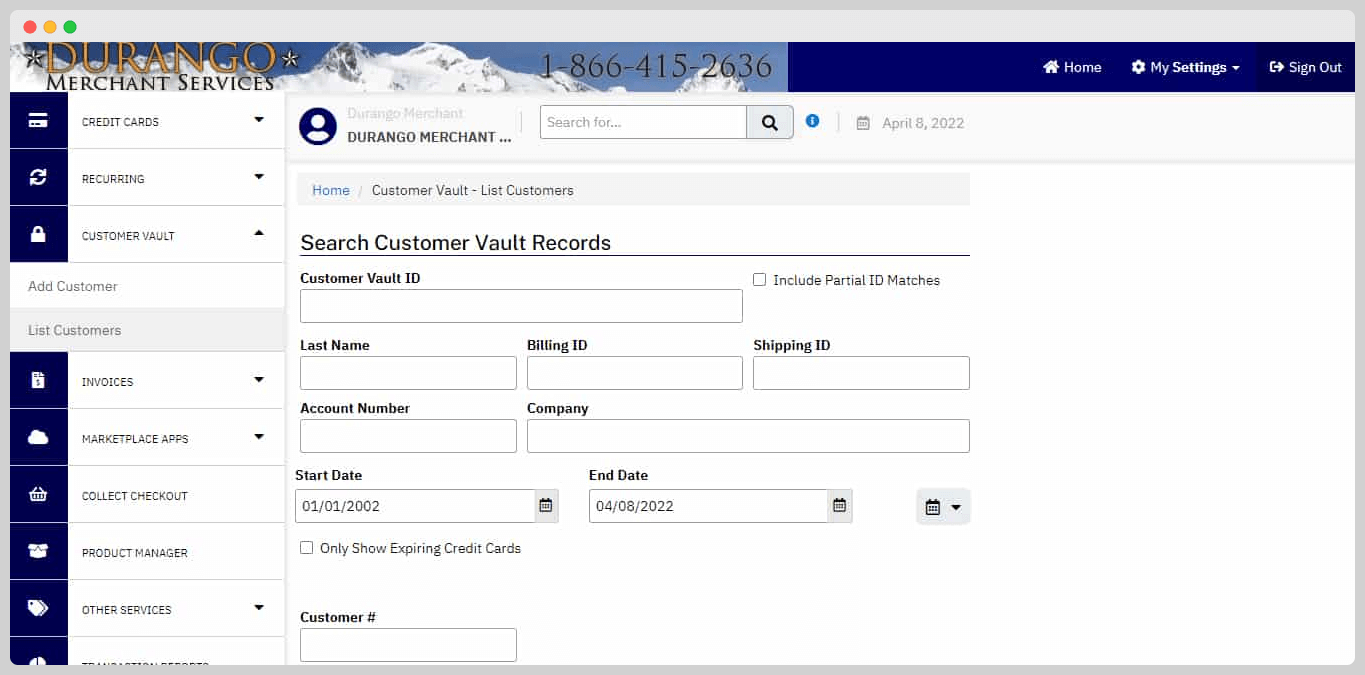
Durango Merchant Services is a long-established US-based high-risk merchant account provider known for working with businesses that most processors will not touch. It is commonly used by companies in regulated or restricted industries that need stable, long-term card processing rather than fast approvals.
Durango supports some of the most difficult verticals to place, including firearms and ammunition, adult and adult dating, CBD and hemp products, supplements, travel, online subscriptions, lead generation, and other businesses with elevated chargeback or compliance risk. It also works with both domestic and international merchants.
Pricing is customized based on the business model, risk level, and processing history. Fees are typically higher than standard processors and may include setup costs, monthly account fees, rolling reserves, and longer settlement periods. Exact rates are provided after a full underwriting review.
Best for: businesses in highly regulated or restricted industries that need a specialist high-risk processor with deep banking relationships.
PaymentCloud
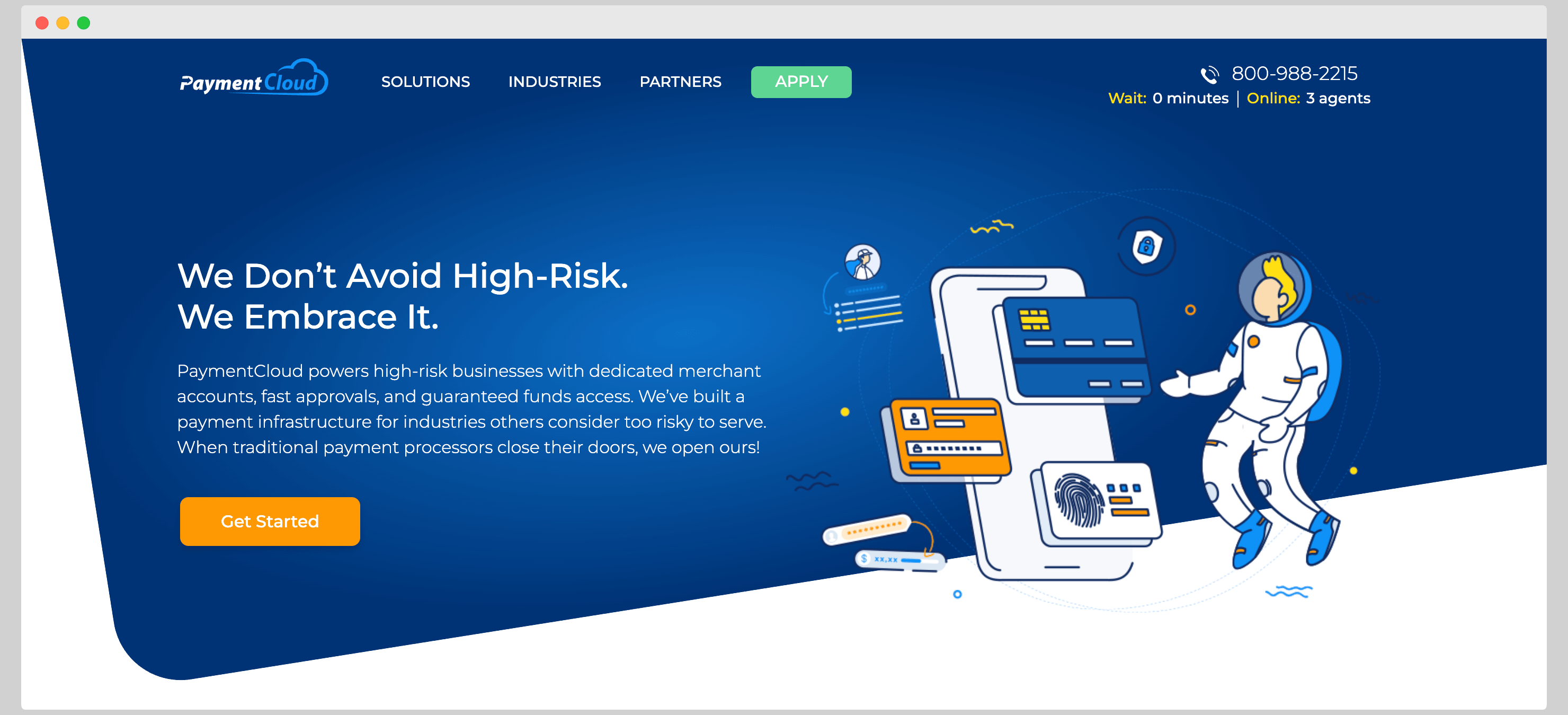
PaymentCloud is a US-based merchant account provider that focuses on placing businesses considered too risky for mainstream processors. It is commonly used by online and offline merchants who have been declined by Stripe or PayPal and need a more flexible underwriting approach with long-term account stability.
PaymentCloud works with a wide range of hard-to-place industries, including ecommerce, subscription-based services, CBD, supplements, firearms and accessories, adult-oriented businesses, travel, tech support, nutraceuticals, and other regulated or high chargeback sectors. It also supports both card-present and card-not-present transactions.
Pricing varies depending on risk level, volume, and processing history. Merchants should expect higher transaction fees than standard processors, possible setup or monthly fees, and rolling reserves in some cases. Rates and terms are disclosed after underwriting and are structured to reflect the actual risk profile of the business.
Best for: US-based hard-to-place merchants that need a traditional merchant account with predictable payouts and human-led underwriting.
HighRiskPay
HighRiskPay is a high-risk merchant account provider that focuses on businesses rejected by standard payment processors. It is commonly used by online merchants operating in regulated, subscription-based, or higher chargeback industries that need stable card processing rather than instant approval tools.
The company supports a broad range of high-risk sectors, including e-commerce, supplements and nutraceuticals, CBD, online coaching and courses, lead generation, adult services, travel, tech support, and other digital-first business models that are difficult to place with mainstream providers.
Pricing depends on the business risk profile and processing history. Transaction fees are typically higher than low risk processors and may include application fees, monthly account fees, rolling reserves, and longer settlement times. Rates are set after underwriting and vary by industry, volume, and chargeback exposure.
Best for: online businesses in high-risk industries that need reliable card processing after being declined by platforms like Stripe or PayPal.
First Card Payments
First Card Payments is a UK-based merchant account provider that works with businesses that struggle to get approved by mainstream processors. It is commonly used by e-commerce brands, service businesses, and online merchants that have been declined by providers like Stripe due to risk profile, transaction patterns, or industry classification.
The company supports a wide range of harder-to-place sectors, including e-commerce and online retail, subscription-based services, digital goods, lead generation, coaching and online education, adult adjacent services, and other higher-risk online business models. It also works with international merchants that need acquiring outside their home country.
Pricing varies based on risk level and processing history. Fees are usually higher than standard processors and may include setup fees, monthly account fees, higher transaction rates, and rolling reserves. Exact pricing is quoted after underwriting and depends on volume, chargeback ratios, and business model complexity.
Best for: UK and EU merchants that have been declined by mainstream processors and need a traditional merchant account with higher approval tolerance.
Get the best high-risk payment processor for your business today
If traditional payment gateways are a no-go, high-risk merchants are an excellent alternative payment method to keep your cash flow and accept payments from credit and debit cards. These merchant service providers have become specialized for high-risk verticals.
You’ll get competitive pricing, technical support, chargeback and fraud protection, and a predictable way to get paid.
Get approved for a merchant account in less than 24 hours
Frequently asked questions
1. Why are some businesses considered high risk by payment processors?
A business is considered high risk when banks expect higher chargebacks, refunds, fraud, or regulatory exposure. This often applies to subscription billing models, cross-border sales, or industries operating in the high-risk space where card networks apply stricter rules.
2. Why do e-commerce businesses struggle with processors like Stripe?
Many e-commerce businesses sell subscriptions, digital goods, or future delivery products, which increases dispute risk. Standard processors rely on automated risk rules, so even healthy merchants can face sudden holds or shutdowns when activity falls outside preset limits.
3. What is full-service payment processing and how is it different?
Full service payment processing includes underwriting, acquiring bank access, risk monitoring, chargeback support, and ongoing account management. Unlike aggregators, these accounts are built for long-term stability rather than instant approval.
4. Do high-risk merchant accounts support subscription billing?
Yes. High-risk merchant accounts are designed to support subscription billing with clearer rules around renewals, refunds, and dispute management. Terms are agreed upfront, which reduces the chance of unexpected account freezes.
5. What is a proprietary payment gateway, and when is it needed?
A proprietary payment gateway is a gateway configured specifically for high-risk processing requirements. It allows more control over fraud rules, transaction routing, and compliance compared to generic gateways used by mainstream platforms.
6. Why are rolling reserves common in the high-risk space?
Rolling reserves protect acquiring banks against refunds and chargebacks. While they increase short-term cash constraints, they are disclosed upfront and predictable, unlike surprise holds applied by standard processors after issues appear.
7. What should merchants know about fees and account management?
High-risk accounts may include higher processing fees, early termination fees, and rolling reserves. In return, merchants receive dedicated account managers, PCI-compliant payment processing, and support built for long-term account survival rather than short term volume.